
Making names
with To Rakiura and Beyond, by Sandra Turner

I chose the name To Rakiura and back partly because I’m unimaginative.
It was like that feeling of having to come up with something witty for your group name at a quiz night, but also having it represent an emergent thing that you care about, equally deep as it will be banal, with the itchiness of just wanting to get on with it and write. Naming things is hard.
In saying that, it is not without meaning or thought. To Rakiura and Beyond is the name of mum’s book, named itself after a particular piece of her writing, which I have reproduced below. This piece talks, to me at least, about learning to ride the waves, through the storm and the calm. And that you get to choose how to do that.
The image on the front of the book was gifted by mum’s colleague, Walter Logeman.
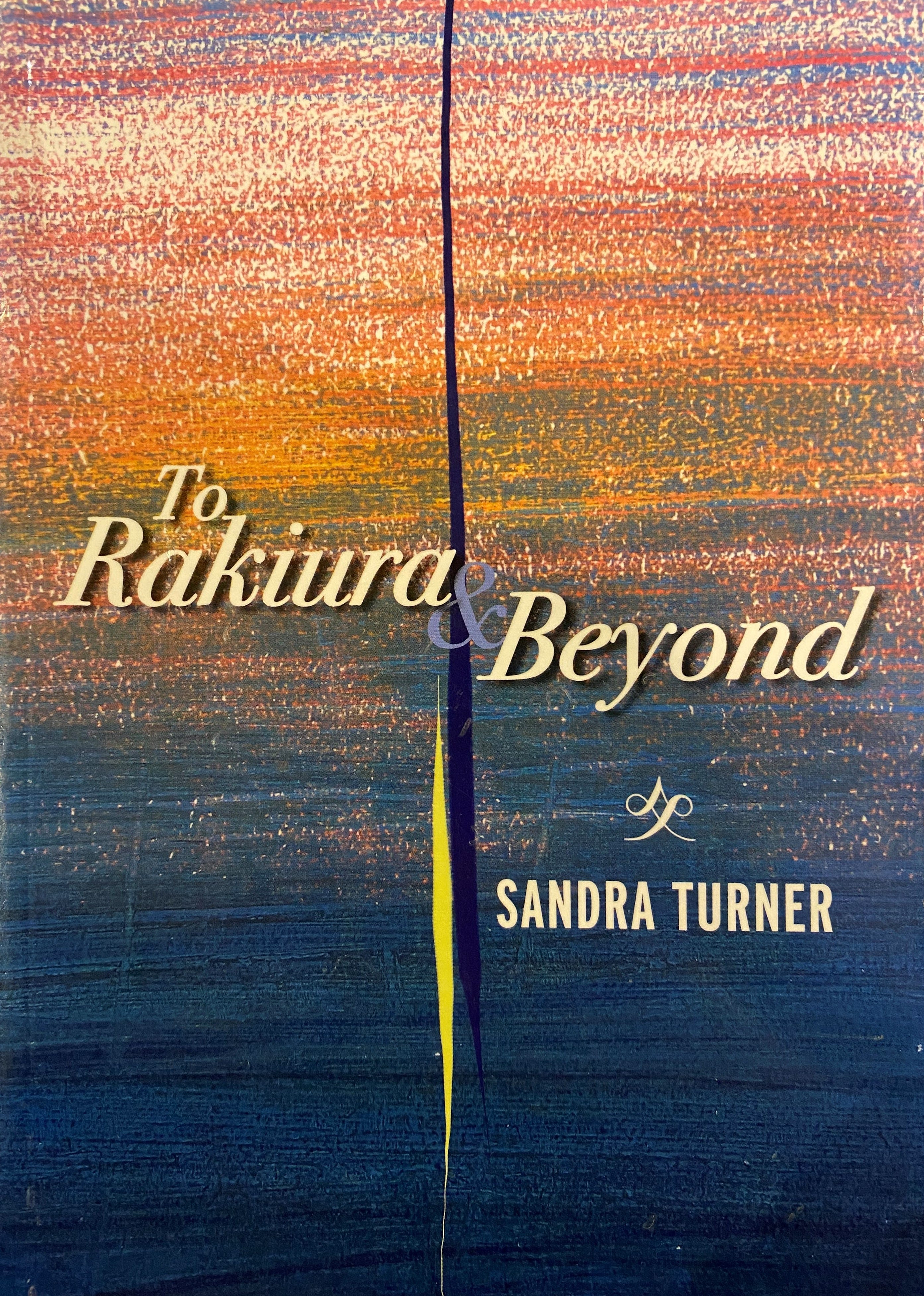
And without overriding anyone who has found their own meaning in it, my understanding of what mum saw in this image comes from some words towards the end of the book, in Part 3: Facing Jerusalem.
Some years later, whilst facing progression of the disease, I knew that a fuller reworking of my spirituality was yet needed. My current beliefs were not longer holding up and needed a thorough revisiting at their core base. I had become frightened and knew deep in myself that I did not want to die frightened. A week long silent retreat, punctuated only by the sessions for spiritual direction, gave me the space and challenge I needed to come to a new place. The retreat house, in the Christchurch seaside suburb of Sumner, overlooked the Pacific Ocean and I soon found myself spending my days meditating on the horizon of where the sea met the sky. There were times when I could distinguish it clearly and others when it just seemed to move and merge. It was difficult to determine just where it was or how far away. Yet the seascape and sky, even with its bigness and changeability, remained a constant.
Our horizons are fluid, moving in and out of focus. Your option is to settle in and trust that which is constant.
I chose To Rakiura and back because, to me, this puts us in conversation with each other; one of us across the horizon, the other here in the living world.
And I will go to Rakiura, I will bear the crossings.
But I am not yet ready to go beyond.
I will come back.
To Rakiura and Beyond
by Sandra Turner
Rakiura lies at the southernmost point of New Zealand
separated from the South Island by Foveaux Strait.
The ferry has just arrived. Standing by the jetty with our bags,
food, books and tramping gear all piled up
we watch as the old lady discharges her load.
Weak kneed and grim, her passengers stumble up the gangplank
onto the jetty, collapsing quickly on the nearest seat.
This has been a rough crossing.
We board and endeavour to settle ourselves for the trip across.

The wind can blow hard through this channel where the great oceans of the Tasman and Pacific converge. Sheets of rain slash onto the ferry as she pounds through the waves. There is no rhythm, nothing to settle into, each moment is violently jarred by the next.
In this cargo of locals and visitors, each of us adopts our own way of survival. There are those who determinedly engage in casual conversation as if the storm did not exist, others slump into the inevitability of it all with a paper bag already positioned under bended head. Some are outside, holding fast to the rails, riding the waves with each thump, lashed by the rain and sea they are determined to show they are as big as the storm. No cowering to be found here. The sheer energy needed to hold into the storm eventually depletes the, the rush of adrenaline giving way to a cold misery. Standing quietly under the canopy, a young man fixes his glazed eyes on the horizon, feet grounded and knees flexed, he steadies himself in the storm’s turmoil. We reach the other side, the haven of Half-moon Bay. We disembark, gathering our belongings and ourselves back together.
The return journey is the stuff of travel brochures. We glide across this calm emerald sea that dances and twinkles in the sunlight, marvelling at the ease and beauty that surrounds us. Our mood is light as we play with the wind and each other.
If you travel between these islands, you take whatever crossing you get. The ferry captain rarely cancels. The elements are big, the wind and the sea do what they will. Some days are easy, others are as hard as they can get.